Sunday, August 31, 2008

Green Tip for Today

Food and Drug Administration Mercury Advice on Fish and Seafood

In March 2004, the Food and Drug Administration (FDA) and Environmental Protection Agency (EPA) issued the following joint advice for women who might become pregnant, women who are pregnant, nursing mothers and young children:

1. Do not eat Shark, Swordfish, King Mackerel or Tilefish because they contain high levels of mercury.

2. Eat up to 12 ounces (2 average meals) a week of a variety of fish and shellfish that are lower in mercury.

Five of the most commonly eaten fish that are low in mercury are shrimp, canned light tuna, salmon, pollock, and catfish.

Another commonly eaten fish, albacore ("white") tuna has more mercury than canned light tuna. So, when choosing your two meals of fish and shellfish, you should limit your consumption of albacore tuna to 6 oz. (one average meal) per week.

Learn More

Check out What You Need To Know About Mercury In Fish and Shellfish on the FDA website.

Check out Mercury Levels In Commercial Fish and Shellfish on the FDA website.

Download Oceana's Guide to Ocean-Friendly Seafood, which includes flags on high-mercury fish.

Economic Impact of Living Oceans

The results of a study by Oceana show a strong economic incentive for protecting living ocean resources. Sea the Value: Quantifying the Value of Marine Life to Divers shows that scuba divers are willing to pay more to see healthy corals, sharks and sea turtles.

Average additional amount scuba divers are willing to pay per dive to view wildlife and the total annual value across all six million dives taken in the United States

Value (U.S. $)

Sea Turtles

Sharks

Healthy Corals

Average Per Dive

$29.63

$35.36

$55.35

Total Annual Value

$177.8 million

$212.2 million

$332.1 million

Scuba divers find personal value in seeing healthy marine life when they explore the underwater world. Quantifying this value is important, in part because it provides economic justification for the protection of marine wildlife. In fact, divers are valuable participants in ecotourism and provide economic incentives for coastal areas to protect and preserve the oceans.

via Oceana


In Texas, we have learned to put an economic impact on our tourism. Birding, dude ranches, rodeos, motels/hotels, jet boat races, fishing, hunting, you name it. Put a dollar value on it so that it is made important and real. I believe if we did this for all our natural resources, it would change the way we view our world.

What about the economic impact of bays and estuaries on the commercial fishing industry?
Or economic impact of the dead zone and red tide on sports fishing?
The economic impact of losing 5 feet of coastal lands worldwide on life itself?
The loss of lakes and rivers in the southwest on tourism and development?

We will not know the true value of what we have lost until it is gone.


Do You Worry about Losing Data?

Have you ever lost all your data, pictures, documents and files? I have. It is an awful feeling to know that you could have saved all your precious memories and business files by backing up your data.

I am going to show you just how easy it is to backup 2 gigabytes of files using IDrive for Windows by Pro Softnet Corporation. Why would I choose an arbitrary figure like 2 gigabytes for Online Backup? That is how much IDrive will store for you, free, forever.
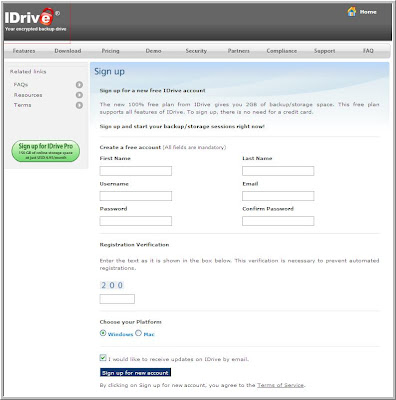

The first thing you should do is register (screenshot above) and download the software (screenshot below). It takes a few minutes and you are ready to start saving your files from a future mishap.
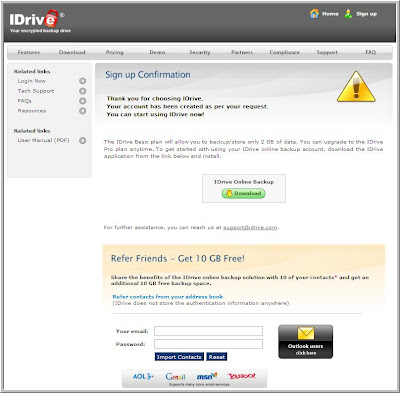

After the software downloads, take a moment to view the demos and download the manual. I would view both of the demos because you will be using both the IDrive Classic interface to backup your files and the IDrive Explorer interface to restore your files.
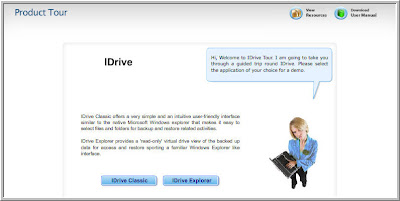

The Classic interface is menu and screen driven and allows you choices along the way to backup. It also allows you to use your own encryption key and password. The Explorer interface is more intuitive because it appears as a networked drive under My Computer and you may simply drag and drop files to be restored.

Simply run the IDriveSetup.exe file to start installation. After installation, the IDrive login screen appears. Use the same information with which you registered before you downloaded the software. Then the encryption screen pops up, asking if you want to use your own encryption key or allow IDrive to use its encryption key. This is your personal choice. If you do choose your own key, make sure you remember it.
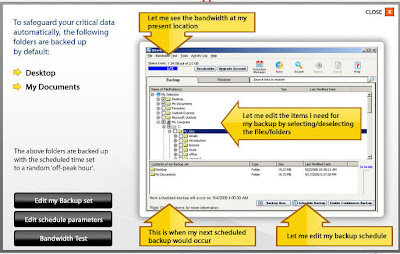

Next, you will see the screenshot above that highlights choices and options you may want to make. You may either keep the default settings or personalize your backup. IDrive will automatically schedule a backup for your most important folders, such as Documents, Pictures and Videos. You may stay with this schedule, amend the schedule and documents to be backed up or pick the files you want saved and backup now.

I would be remiss if I did not tell you that the IDriveBasic is as fully featured as the IDrivePro for personal use and the IDrivePro for business. The only difference is the storage allotment. The features include Automatic Backup, True Archiving, Versioning, Continuous Backup, Mapped Drive Backup and Web-based Backup Management. IDrive made this entire process so incredibly easy that I have backed up almost 1 megabyte of data in under 2 hours.

If you have a business and you are not backing up your data, you are courting disaster. The wonderful thing about IDrive is that it will work on a Mac computer, you may manage your data from any computer and if your office floods, you will have your data stored n a secure location. After all, it is hurricane season again?!


Saturday, August 30, 2008

Green Tip for Today

What to do with burned out CFLs?

Lately, we have heard that the small amount of Mercury in CFLs could be an environmental problem. Well, that problem is solved.

The Home Depot will accept unbroken consumer compact fluorescent light bulbs (CFLs) at all locations. The services if free. Just turn in your CFLs to the clerk at the Returns desk.

If every American swapped one incandescent bulb for a CFL, it would save enough energy to light more than 3 million homes for one year, save more than $600 million in annual energy costs and prevent greenhouse gases equivalent to the emissions from 800,000 automobiles.

Big Plans for America

I was really inspired by the environmental message in Obama's speech at the convention.

I'll help our auto companies re-tool, so that the fuel-efficient cars of the future are built right here in America. I'll make it easier for the American people to afford these new cars. And I'll invest 150 billion dollars over the next decade in affordable, renewable sources of energy - wind power and solar power and the next generation of biofuels; an investment that will lead to new industries and five million new jobs that pay well and can't ever be outsourced. America, now is not the time for small plans.


Treat the earth well

It was not given to you by your parents,

it was loaned to you by your children.

We do not inherit the Earth from our Ancestors,

we borrow it from our Children.


Ancient First American Proverb

Keep Health Care Options for Women Open

Protect Access to Health Care

The Bush Administration has proposed regulations that could seriously undermine the ability of American women to get basic reproductive health care, including birth control and abortion. The regulations put politics above women’s health care needs.

As currently written, the rule leaves open the possibility that based on religious beliefs institutions and individuals can deny women access to birth control. It also permits individuals to refuse to provide information and counseling about basic heath care services. And it expands existing laws by permitting a wider range of health care professionals to refuse to provide even referrals for abortions.

For years, federal law has carefully balanced protections for individual religious liberty and patients’ access to reproductive health care. The proposed regulations appear to take patients’ health needs out of the equation, leaving millions of Americans who depend on federally funded reproductive health care services with no protections.

Tell the Bush Administration to Reinstate Patient Protections and Stop the Health Care Refusal Regulations.

According to researchers at the Guttmacher Institute -- a nonprofit think tank on sexual and reproductive health -- without the contraceptive services provided at publicly funded clinics, there would be 46 percent more unintended pregnancies (1.4 million more) annually in the United States than currently occur.

At a time when more and more Americans are either uninsured or struggling with the soaring costs of health care, the federal government should be expanding access to important health services, not undermining existing protections or interfering in programs that have successfully provided services for years.

Take Action: Tell the Bush Administration to Reinstate Patient Protections and Stop the Health Care Refusal Regulations.


Friday, August 29, 2008

Green Tip for Today

How Efficient is Your Water Heater?

Water heating accounts for approximately 15 percent of the average household’s total energy consumption. If your water heater is more than 10 years old it is likely running at less than 50 percent efficiency.

To purchase the most efficient storage water heater for your needs, you need to know two numbers: first-hour rating (FHR) and energy factor (EF).
  • FHR represents the amount of hot water your family uses during its busiest hour; the U.S. Department of Energy offers a worksheet to help you determine this amount,

  • EF represents how efficiently the appliance operates, with higher values signifying better efficiency. EF ratings typically range from 0.75 to 0.95 for electric water heaters, and 0.50 to 0.70 for natural gas-fired water heaters.
Storage Water Heaters

Heaters that maintain a large tank of water at a set temperature are the most common, and are best suited for larger households that use a lot of hot water. They have become more efficient over the years, but some energy is still wasted when the hot water is not being used.

Tankless Water Heaters

Also known as on-demand or instantaneous heaters, these devices use energy only when hot water is needed, resulting in less standby energy loss than storage heaters. They tend to have a higher up-front cost, but are less expensive to operate in the long term due to their higher efficiency. When choosing a tankless water heater, you must first determine your required flow rate, or the total hot water consumption of the appliances you need to run simultaneously.

Solar Water Heaters

By transferring heat from the sun into a conventional storage tank, solar water heaters can supply part or all of your hot water needs. They have higher up-front costs than conventional water heaters but much lower operating costs, and can pay for themselves within 4 to 10 years under favorable conditions.


Related Links:

U.S. Department of Energy—First Hour Rating Worksheet

U.S. Department of Energy—Sizing a Tankless Water Heater

Database of State Incentives for Renewable Energy

American Council for an Energy-Efficient Economy—Top-Rated Water Heaters


via Union of Concerned Scientists

Thursday, August 28, 2008

OLEDs May Be Lighting Our Future

Recent developments and announcements from major developers of organic electroluminescence technology seem to be pointing towards the conclusion that 2011 will be the year where the first commercial lighting applications will appear on the market.

Organic light-emitting diodes (OLEDs) are made by layering sheets of glass or plastic with organic compounds that luminesce when exposed to electricity. They are capable of producing 102 lumens of light per watt. In contrast, regular light bulbs produce 13 lumens per watt and flourescent tubes produce between 50 to 90 lumens per watt.

Examples of potential applications include:

* Illuminating room switches, desk drawers, staircases etc.
* Illuminating accessories
* Underwater lighting
* Interior lighting for vehicles

To see OLEDs in action, visit the Research Institute for Organic Electronics.

If you live in Southern California, you may want to attend:
Organic Electronics Week 2008
Monday, November 10, 2008 - Friday, November 14, 2008
Hilton Torrey Pines
La Jolla, CA

Webinar : Cheaper by the Gallon

Cheaper by the Gallon: Natural Gas Fueling Fleet Transportation Needs

Tuesday, September 16, 2008
10:30 a.m. Pacific Time (1:30 p.m. Eastern Time)

Fueling costs got you down? Alternative Fuel Vehicle Institute (AFVi) knows how to get your fueling costs down and all it will cost is 90 minutes of your time. “Cheaper by the Gallon: Natural Gas Fueling Fleet Transportation Needs” is a webinar designed for fleets looking for clean, affordable, alternatively fueled medium- and heavy-duty vehicles.

Annalloyd Thomason, Executive Director of AFVi is the webinar moderator. Guest speakers include Jeff Seisler, Principal, Clean Fuels Consulting; Greg Roche, Director of Business Development for Clean Energy; and Leo Thomason, Executive Director of the Natural Gas Vehicle Institute.

Participants will learn what is driving market interest in natural gas as a vehicular fuel, the per gallon cost benefits, government incentives, emissions performance over diesel and gasoline, and a preview of vehicles available to order today. There will also be a question and answer period at the end of the webinar.

Registration is free, courtesy of Foton-America, which offers CNG transit buses as well as medium- and heavy-duty trucks. Registration is limited to the first 250 people and you must register to participate. Sign up here, now.


Green Tip for Today

Going Camping?

Did you know that by transporting firewood you may unintentionally spread invasive insects and diseases that can destroy trees and reshape entire forests? State and federal quarantines attempt to prevent such damage by prohibiting firewood transport into or out of certain areas, or limiting transport to a specified radius.

via Union for Concerned Scientists

Endangered Species Act is Endangered

URGENT ACTION:

Submit Comments to Protect the Endangered Species Act!


Deadline:
September 15, 2008

A leaked document obtained by the National Wildlife Federation recently revealed that the Bush administration is planning on weakening the Endangered Species Act in its last few months in office.

Just days after this news broke, a public comment period was opened to get input as to what Americans think about their dangerous proposal.

However, this comment period is suspiciously short (30 days!), and it lacks a direct email address where wildlife advocates can send input.


Instead, public input must be submitted through a special online form or by postal mail. We want to help make sure your voice is heard.

Steps for Submitting Comments Online

  1. Click here to go to the "Interagency Cooperation Under the Endangered Species Act" page on Regulations.gov.
  2. Click on the yellow speech bubble next to Add Comments.

    Add Comments

  3. Fill out the "Submitter Information."
    Note: Don't worry about filling out Organization Name, Submitter's Representative, Government Agency Type or Government Agency if you are just a private citizen submitting comments.
  4. Enter your comments into the box under "Public Comment or Submission." If you need a few talking points about what to say, check out the talking points on the right column of this page.
  5. Scroll down and click "Next Step."
  6. Click "Submit."

Wednesday, August 27, 2008

Big Oil Wants It All!


Did you know that oil companies are already sitting on 68 million acres of leases that they have not drilled?

Why is Big Oil suddenly desperate to get their hands on the last few places that are still protected -- our natural treasures, wildlife refuges, and pristine coastlines? They are using concerns about high gas prices as an excuse to grab it ALL.

Big Oil and its allies would like you to think that more drilling will ease your pain at the pump, but that's not the truth. More oil drilling will not lower gas prices or create energy independence, it will only make the world's richest oil companies richer.

Average Americans are being squeezed by high energy prices, and the oil companies are taking advantage to push their long-term drilling agenda. They have been spreading a map full of lies though the Internet.

Via The Sierra Club

Help us counter their propaganda -- pass this map and the truth along to your friends and ask them to pass it along too.

Tuesday, August 26, 2008

Green Tip for Today

SAVE GAS

Do you drive around with extra stuff in your car or trunk? Unload it and save gas. I have a bad habit of buying items like potting soil, cat and dog food and cat litter and leaving them in my trunk until I need them. Every extra pound of weight cuts your gas mileage.

Think about it for a minute. Here are just a few things I used to carry around on a daily basis at different times in my life.
  • sand toys, molds and cups
  • swimsuits, towels, river shoes and floats
  • roller blades, skate boards and helmets
  • cans of oil or transmission fluid
  • soccer shoes, pads and uniform
I know people made fun of Obama and his "inflate your tires" advice, but it was good advice. So is unloading your car.


Monday, August 25, 2008

Compost Happens

The average American throws away more than 4 pounds of trash every day. Almost one-half of this trash is organic and could be composted.

For food waste, use a dishwasher-safe ceramic composting crock pot or other small vessel to collect scraps right on your kitchen counter. Toss in just about everything that isn't dairy, meat, fish, or oils and fats.

All you need to start your compost system are:

GREENS, which are nitrogen-rich
  • fresh grass
  • plant clippings
  • fruit and vegetable parts
  • coffee grounds (with or without filter)
  • tea bags
  • wool
  • human hair
BROWNS, which are carbon-rich
  • dead leaves
  • brown grass clippings
  • wood
  • sticks
  • shredded newspaper
  • dead plants and flowers
  • rice
  • pine needles
Collect GREENS and BROWNS in containers on your deck, balcony or other outdoor spot. You can buy small composting bins online or make your own bin.

We have huge piles of compost in different stages in our yard. I had to start a separate pile for Johnson Grass because I will need to burn it when it is reduced. Either that or send it to landfill, which I refuse to do. Never compost weeds or diseased plants unless you want to grow more. I learned this the hard way. LOL

With compositing and recycling, I have less than one container of garbage each week. My plan is to totally do away with garbage collection for my household. Zero-waste. Wish me luck.


Green Tip for Today

When picking your child up at school, stop idling! 10% of all of our fuel is wasted on idling. After only 10 seconds, you use less gas turning the ignition off. This also applies to bank lines, fast food drive through lanes, waiting outside stores for someone to pick up a quick item, etc.

From Stop Global Warming.Org


Sunday, August 24, 2008

Green Tip for Today

By switching to biodegradable wood cards, hotels and resorts can reduce plastic waste by 1,300 tons annually -- an amount of plastic waste equal to the volume of seven Boeing 777 airplanes.

via From Stop Global Warming.Org

Saturday, August 23, 2008

Green Tip for Today

Take shorter showers. Two minutes less shower time can conserve more than ten gallons of water. If everyone in the U.S. saved just one gallon from their daily shower, over the course of the year it would equal twice the amount of freshwater withdrawn from the Great Lakes every day.

From Stop Global Warming.Org

Friday, August 22, 2008

Use Shark Livers On Your Face?

Dr. Susan Lark promotes squalane – an ingredient found in shark livers - for its ability to help skin “maintain its moisture and elasticity.” But squalane can be obtained from a much more abundant source: olives.

Deep-sea sharks are some of the most vulnerable sharks in the world. They typically grow slowly, mature late in life and have only a few young during their long lives. As a result, deep sea shark populations are at extreme risk from exploitation and recover very slowly.

Tell Dr. Lark she ought to leave deep-sea sharks alone. In fact, you may want to include in your message that you will not buy beauty (or any) products that contain animal products or that are tested on animals.

I just took action to protect sharks, will you? Go to Oceana and take action today.

Thursday, August 21, 2008

Endangered Species : Single Adults?

Talking about endangered species, let us talk about dating relationships in the 21st Century. How do you meet people? Bars are unsafe. Church is safe but dull. Parks with your big dog is safe and a great way to meet people. Chat rooms can get you into trouble and who can keep up with the screen names. Coworkers are not a good choice, but their friends might be. How do you meet people with which you have something in common?

Have you ever thought of trying an online dating site? If you are tired of wondering what to do about your social life, you may want to visit Prime Dating Sites.com. Prime Dating Sites reviews all the well-known dating and matchmaking sites, like Perfect Match, eHarmony.com, Yahoo Personals, Matchmaker.com, Date.com, Lava life, Chemistry.com, Match.com, Friend Finder and American Singles.

Each online dating service is different. Some, like eHarmony are matchmaking sites. They want to help you find your soul mate, marry and begin your life together. For those individuals who are looking for anything from casual dating to intimate encounters to long-term relationships, Lavalife might be the best online dating service for you. If you are too shy to make the first move, Date.com will introduce you to other members by sending both of you a message.

Each online dating service has its on inimitable style and way of going about the business of dating and matchmaking. Prime Dating Sites.com reviews each of the Top 10 and lets you decide if the service is for you.

So if you are feeling socially endangered, visit Prime Dating Sites.com and read up on the latest way to meet others online. In cultures where matchmakers are still hard at work, family stability results. Whether you want to meet the father of your children or just have some fun at the beach, why not try something new? This is your LIFE.


Thursday, August 14, 2008

Where Telephones Go to Die


Look at the heads and the feet


Do We Need an Endangered Species Act?!?


According to the National Wildlife Federation, the Bush Administration is planning to rollback protections for America's imperiled wildlife by rewriting the regulations of the Endangered Species Act.

If adopted, these changes would seriously weaken the safety net of habitat protections that we have relied upon to protect and recover endangered fish, wildlife and plants for the past 35 years.

According to NWF's John Kostyack, Executive Director of Wildlife Conservation and Global Warming:
Do not be fooled when the Administration claims it is merely tweaking the law. The cumulative impact of these changes equals a full blown attack on America's premier conservation law. We owe it to future generations to stop this attack and continue our legacy of protecting wildlife on the brink of extinction.

Please click the graphic above to
TAKE ACTION. TAKE BACK OUR COASTS.

Protection for the coastlines of the USA will expire on September 30, 2008.

This means oil companies will be able to drill for oil off beaches that have been protected. There is no good reason to allow oil drilling on our protected coasts.

Even the Bush administration’s Energy Information Administration says that off-shore drilling will have an “insignificant” effect on gas prices, even in the long-term.

The real solution to our oil dependence is to get off oil by tapping our technological ingenuity and renewable energy resources.

Wednesday, August 13, 2008

Team Darfur : The Other Olympics

Lopez Lomong was six years old when a militia group kidnapped him from a Sudanese church, determined to turn him into a child soldier. He managed to escape and walk for three days to Kenya. He spent ten years in a refugee camp before finally immigrating to the U.S.

This year, Lopez will compete for the U.S. in the 2008 Olympics. While at the games, he will join Team Darfur, an alliance of almost 400 athletes from around the world raising awareness about Darfur.

Lopez Lomong

Lopez Lomong,
Sudanese refugee and Olympic athlete

Lopez Lomong's story of courage and perseverance is an inspiration and a reminder. Thousands of Darfuri children, driven from their homes and fearing for their lives, deserve the chance to live lives of success and dignity in peace.

The Olympic Games can be a festival of good will, an opportunity for all nations to come together in a spirit of cooperation and common humanity. But tragically, China, the host of this year's games and a permanent member of the U.N. Security Council, isn't living up to these values.

The Team Darfur Olympians are speaking out—let them know you stand with them.

The Team Darfur athletes are speaking out on the Olympic stage, showing incredible courage by advocating for the people of Darfur from the heart of China. Driven by the same determination that made them Olympians, these incredible athletes know that it is our resilience and resolve that will end this genocide.

Send a message of support to Lopez and his fellow Team Darfur Olympians.

Donate to Help Save Darfur - Help build the political pressure needed to end the crisis in Darfur by supporting the Save Darfur Coalition's crucial awareness and advocacy programs.

Click here now to make a secure, tax-deductible online donation.


-----------------------------------------------------------------------------------------

Breaking news: China has revoked the visa for Joey Cheek, Olympic gold-medalist and co-founder of
Team Darfur. This will not stop the other olympians, so show your support.


2008 : Year of the Frog

Agalychnis callidryas
Red-eyed Tree Frog
Gerry Marantelli
www.frogs.org.au


After hundreds of millions of years of existence, almost half of the world's species of amphibians are threatened with extinction.

Loss of habitat, change in climate, pollution and pesticides, and collection for food and pets are all contributing to the crisis.

During 2008, the conservation group Amphibian Ark will lead zoos and aquariums in the Year of the Frog campaign to raise awareness about amphibian extinction.

Click Here to learn more about Amphibian Ark and its conservation efforts and to sign a petition to world leaders to protect all amphibians before it is too late.


Tuesday, August 12, 2008

Switch to Renewable Energy Sources


From We Can Solve It website
:

Switching now to clean energy sources will revitalize our economy -- we can be global leaders in developing and manufacturing clean energy technologies. It will enhance our national security -- reducing the pressure on our troops to protect oil supplies and avoiding the worst climate impacts in politically unstable regions of the world. It will make high gasoline prices less of a burden in our daily lives -- enabling us to transition to clean plug-in hybrid electric cars. It will help solve the climate crisis -- if we fail to act soon, the consequences for our children will be dire.

You will see this ad airing during the Olympics this week. Please take a moment to become part of the solution. Take Action at We Can Solve It

Monday, August 11, 2008

Texas Sales Tax Holiday

If you shop in local stores, this is the weekend to do it in Texas. This post just seemed like a good follow to my shop online post. Warning: hit the stores early or at night to beat the crowds. Lay-away plans can be used again this year to take advantage of the sales tax holiday. So, if you usually buy clothes later in the year, put them on layaway and save.


August 15-17, 2008

Texas shoppers geta break from state and local sales taxes on August 15, 16 and 17 - the state’s annual tax holiday.

The law exempts most clothing and footwear priced under $100 from sales and use taxes, which could save shoppers about $8 on every $100 they spend.

Backpacks under $100 and used by elementary and secondary students are also exempt. A backpack is a pack with straps one wears on the back.The exemption during the sales tax holiday includes backpacks with wheels, provided they can also be worn on the back like a traditional backpack, and messenger bags. The exemption does not include items that are reasonably defined as luggage, briefcases, athletic/duffle/gymbags, computer bags, purses or framed backpacks. Ten or fewer backpacks can be purchased tax-free at one time without providing an exemption certificate to the seller.

List of Items and Their Exemption Status

TAX-FREE

TAXED

  • Baby clothes
  • Backpacks for use by elementary and secondary students
  • Belts with attached buckles
  • Boots - cowboy, hiking
  • Caps/hats - baseball, fishing, golf, knitted
  • Coats and wraps
  • Diapers - adult and baby
  • Dresses
  • Gloves (generally)
  • Gym suits and uniforms
  • Hooded shirts and hooded sweatshirts
  • Hosiery
  • Jackets
  • Jeans
  • Jerseys - baseball and football
  • Jogging apparel
  • Neckwear and ties
  • Pajamas
  • Pants and trousers
  • Raincoats and ponchos
  • Robes
  • Shirts
  • Shoes - sandals, slippers, sneakers, tennis, walking
  • Socks (including athletic)
  • Shorts
  • Suits, slacks, and jackets
  • Sweatshirts
  • Sweat suits
  • Sweaters
  • Swimsuits
  • Underclothes
  • Work clothes and uniforms
  • Accessories (generally) - barrettes, elastic ponytail holders, wallets, watches
  • Backpacks - unless for use by elementary and secondary students
  • Baseball cleats and pants
  • Belt buckles (without belt)
  • Boots - climbing, fishing, rubber work boots, ski, waders
  • Buttons and zippers
  • Cloth and lace, knitting yarns, and other fabrics
  • Dry cleaning services
  • Football pants
  • Golf gloves
  • Handbags and purses
  • Handkerchiefs
  • Hard hats
  • Helmets - bike, baseball, football, hockey, motorcycle, sports
  • Ice skates
  • Jewelry
  • Laundering services
  • Leather goods - except belts with buckles and wearing apparel
  • Pads - football, hockey, soccer, elbow, knee, shoulder
  • Personal flotation devices
  • Rented clothing (including uniforms, formal wear, and costumes)
  • Roller blades and skates
  • Safety clothing, glasses
  • Shoes - bicycle (cleated), bowling, golf
[Click to see an Extended List of Items ]


How Green is Your State?

Each state was ranked in six equally weighted categories: carbon footprint, air quality, water quality, hazardous waste management, policy initiatives and energy consumption. Vermont, Oregon and Washington were top ranked. Texas was low-middle (34 out of 50).

Where is your state on this list?

America's Greenest States - Forbes.com
So who's at the bottom? Mississippi, Louisiana, Alabama, Indiana and, at No. 50, West Virginia. All suffer from a mix of toxic waste, lots of pollution and consumption and no clear plans to do anything about it. Expect them to remain that way.

Offshore Drilling Will Not Help

The USA sits on less than 3 percent of the oil reserves in the world. Even if we drill every corner of America, the oil will only amount to a drop in the bucket and will not have an impact on prices.

New offshore drilling will not address problems today, tomorrow or next year. It is estimated that drilling off Florida's coast would only bring 47 days of oil and 4 months of natural gas, and we would not see any of it for at least 7 years.

Opening our nation's coastline to destructive drilling will only add to the billions in profits already being made by Big Oil, do little or nothing to lower gasoline or natural gas prices for American families or businesses and will keep our nation dangerously dependent on fossil fuels.

The number of new offshore drilling permits has tripled while the Bush administration has been in office and yet we are paying triple for gas as what we were paying in 2001.

It is time to use American ingenuity and technology to become a world leader in alternative energy. This just might save our economy and I know it will save the environment. If we can send people to the moon using slide rules, we can calculate how we can meet our future energy needs.

Sierra Club


An Alligator is the Answer to My Prayers

I have been working on my yard since this spring. My latest project is a dry creek bed with two small water features with solar powered fountains. Every time I decide to add something else, I have to pull out the garden tools and clear more brush, grass and rocks.

Lately, I have been running into HUGE tree roots from the trees cut down last winter because they were too close to the shed. These roots travel underground for 10-20 feet, split and then continue. I cut the roots out of my way and pull them out, but I see a new sprout next time I venture outside. With the heat and the roots, I had just about given up.

Then I saw this new Black and Decker Alligator Power Lopper, which is a safe alternative to chainsaws. Chainsaws are dangerous, polluting and noisy and the chain never stays on the bar.

The Alligator, on the other hand, has many safety features to protect the user. It runs on electricity, so there is no messy mixing of oil and gas, and no loud motors. The Alligator Power Lopper weighs only 2.8 kg (just over 6 pounds), has an enclosed chain, dual handle switching and can handle cutting wood up to 4 inches in diameter.

My mission this week is to Get me a 'Gator and get those roots OUT.

Sunday, August 10, 2008

NEPA : Keep public input in the process

In 1970, the National Environmental Policy Act (NEPA) established protecton for the environment by calling for government agencies to consider environmental impacts in all decisions made.

NEPA requires the government to take into account public input. The Act goes on to say that federal agencies are accountable to the public as the government makes these important decisions.

Now a federal agency is threatening to change key pieces of this environmental law, and we need to act now to protect its integrity, and our oceans.

Read about the problem here.

-or-

Take action here now.


Saturday, August 09, 2008

Shop Online: Save Gas, Money & Time

When I was a child, school ended in May and we started back to school after Labor Day. Of course, this was in Houston and before the age of air conditioning. Now, the children seem to enjoy less and less summer every year. While in Target the other day, I noticed that the school supply lists were already posted and that all the summer items were being discounted to make way for the school supplies.

Reuse, Reduce & Recycle

Before you start shopping, look around your home and see what supplies you have left from last year that you may reuse. It always seems that the children never use the amount of supplies that you are told to buy, so reduce the amount of supplies purchased. If you have more than one child, look at what you may recycle from one child to the other.

Shop Online

One good way to help the environment, while saving your time and your money on gasoline is to buy back to school supplies online. I found this coupon site called Office Deals Info and they have coupons for many popular online stores for computers and related items, such as Apple Store, Best Buy, Circuit City, Dell Computer, HP Store and Newegg. They also have coupons for great places to buy office supplies, such as Office Depot, Office Max and Staples. For school supplies, you may browse online at Target and Walmart or check out the office supply stores.

Using Coupons

Check the expiration date of the coupon, if given, before clicking through to the website to shop. Look for general coupons, such as free shipping and dollars-off with purchase. Remember, unless you live in the same state as the store, you will not pay sales tax on your purchase, which is a savings of almost 9 percent in my town.


Good News! Boreal Forest & Right Whales

I write many stories and relay many petitions to try and stop the defilement of the natural world. Every now and then, there is a happy ending. I wanted to share two of them.


In September of 2007, I wrote Buy Green Paper Products, to spread the word that Boreal bird habitat was being destroyed to make toilet paper, facial tissues, paper towels and other disposable paper products.

Canada’s Boreal Forest is one of the largest unspoiled forests left on earth. It provides breeding grounds for up to 3 billion birds each spring and nearly half of all the bird species in North America depend on the Boreal for survival.

Last month, Canadian officials declared their intention to protect half the country's boreal forests. This action safeguards an area the size of Great Britain against commercial development.


The world’s last remaining North Atlantic right whales won an important victory last month. A federal court held that the Coast Guard must ensure that shipping routes into east coast ports will not negatively impact these struggling marine mammals.

Ship strikes cause at least three deaths per year, and with only 350 of these whales left, even the loss of one brings these animals closer to extinction.


Friday, August 08, 2008

Save the Ocelot from Homeland Security

OcelotProtect the Ocelots of the Lower Rio Grande Valley

Fewer than 100 ocelots still roam the Lower Rio Grande Valley. These few ocelots are endangered by the 70 miles of fence that the Department of Homeland Security is constructing in the Lower Rio Grande Valley. This fence will destroy the thorn scrub habitat of the ocelot and prevent the ocelots from swimming across the Rio Grande to mate.

The border fence would destory large areas of the 130-mile habitat corridor that exists along the Rio Grande. The federal government paid millions of dollars to protect this area, which is now a sanctuary for rare wildlife and supports a thriving ecotourism industry. It is a birding paradise.

In other US-Mexico border areas, Homeland Security officials have been willing to implement projects that avoid fencing and involve habitat improvements. Such alternatives must be considered for the Lower Rio Grande Valley as well, home to 17 threatened and endangered species and great wildlife diversity.

Take action now – urge your member of Congress to support border security alternatives that don't harm wildlife in the Lower Rio Grande Valley.


Thursday, August 07, 2008

Go Gentle into the Good Night

Within the past ten years, I have personally been involved with several unexpected deaths among in-laws and friends. In each case, the deceased, whether he or she knew death was near, did not prepare for their passing. Consequently, the family was left scrambling to make final arrangements.

My mother-in-law died within a week of her diagnosis of pancreatic cancer. Of course, the family was devastated. To ease their pain, my family donated burial space in our family plot and she was laid to rest. Two years later, her husband died suddenly and we buried him next to her, also in our family plot.

As we cannot predict or control the manner of our death, we should leave a financial buffer to help our families while they are grieving. The purchase of final expense insurance, better known as funeral insurance, will protect your family against the expenses of an unexpected burial or cremation.

There are other insurance products that are helpful to have, like mortgage life insurance that pays off your home mortgage upon your death. Purchasing mortgage protection insurance will make your house payment if you suddenly become disabled. Last, but not least, term life insurance will pay a set amount of money directly to your beneficiary upon your death. This is money to live on while the will is probated and the home and other assets are sold.

While nothing is going to make your passing easy for your family, do not add to their grief by leaving debt that must be paid or funeral arrangements to be made.


Saturday, August 02, 2008

Please Watch and Decide

I normally stay away from politics as much as possible. However, this was just too alarming to ignore, especially when you read the post below this one.

Friday, August 01, 2008

EDF : Transportation By the Numbers

Read Transportation by the Numbers from Environmental Defense Fund for some interesting facts about oil and prices, the impact of increased energy costs on public transportation and the fallacy of the immediacy argument for offshore drilling.
  1. 96 Percent of the world's transportation energy currently supplied by oil.

  2. $75-Cost of barrel of oil on July 18th, 2007.

  3. $131-Cost of barrel of oil on July 18th, 2008.

  4. 9.6 billion-Number of fewer miles Americans drove in May 2008 compared to May 2007.

  5. 10.3 billion-Number of trips taken via the U.S. public transportation system in 2007, the highest in 50 years.

  6. 44 Percent-increase in price of diesel fuel paid by public transit agencies.

  7. 20 Percent of America's public transit agencies that are cutting services due to budget constraints.

  8. 46 Percent of population that has no access to public transit.

  9. $6,251-Amount the average two-worker household saves annually by taking public transportation instead of driving a car.

  10. 2030-Year by which lifting the ban on offshore drilling may start to impact the price of gas.

Come Together : Right Now : Over Trees

GreenPeace copied the advertisement for Unilever's "Onslaught" ad on YouTube to great affect to spread the message about palm oil and deforestation.


Now they want YOUR help to do the same thing to the European Commission.

Read the article: Show the forests some love from Greenpeace International
The European Commission has delayed a vital vote on protecting forests from illegal logging till September. We want to make sure the commissioners don't forget about it during their summer holiday. We need you to help us make an extra impression before the September vote.
So, grab your digital or video camera and film yourself giving some love to a tree. Post it as a comment to the following video.


Warning : Graphic Tree Sex

Take action here
.

America's Most Endangered Rivers™: 2008 edition


Catawba River 100px#1. Catawba-Wateree River

Threat: Outdated water supply management

Act Now

Rogue River 100px#2. Rogue River

Threat: Logging and road construction
(for OR residents only)

Act Now

AR7 Blue Rule 230

Cache la Poudre 100px#3. Cache la Poudre River

Threat: Water diversion and reservoir project

Act Now

AR7 Blue Rule 230

St. Lawrence River 100px#4. St. Lawrence River

Threat: Outdated dam management plan


Act Now

AR7 Blue Rule 230

Minnesota River 100px#5. Minnesota River

Threat: Proposed coal-fired power plant

Act Now

AR7 Blue Rule 230

St. Johns River 100px#6. St. Johns River

Threat: Unsustainable water appropriations

Act Now

AR7 Blue Rule 230

Gila River 100px#7. Gila River

Threat: Water development project
(for NM residents only)

Act Now

AR7 Blue Rule 230

Allagash River 100 px#8. Allagash Wilderness Waterway

Threat: Loss of Wild and Scenic River protections

Act Now

AR7 Blue Rule 230

Pearl River 100px#9. Pearl River

Threat: Irresponsible floodplain development

Act now

AR7 Blue Rule 230

Niobrara River 100px#10. Niobrara River

Threat: Unsustainable irrigation diversions

Act Now

AR7 Blue Rule 530


via American Rivers: Action Alerts